AUDIOWALK


LIVE NOW
Test link
PIN VIDEO

18/05/2026, GATHERING
Ente di decolonizzazione, 2021


Haṣīra
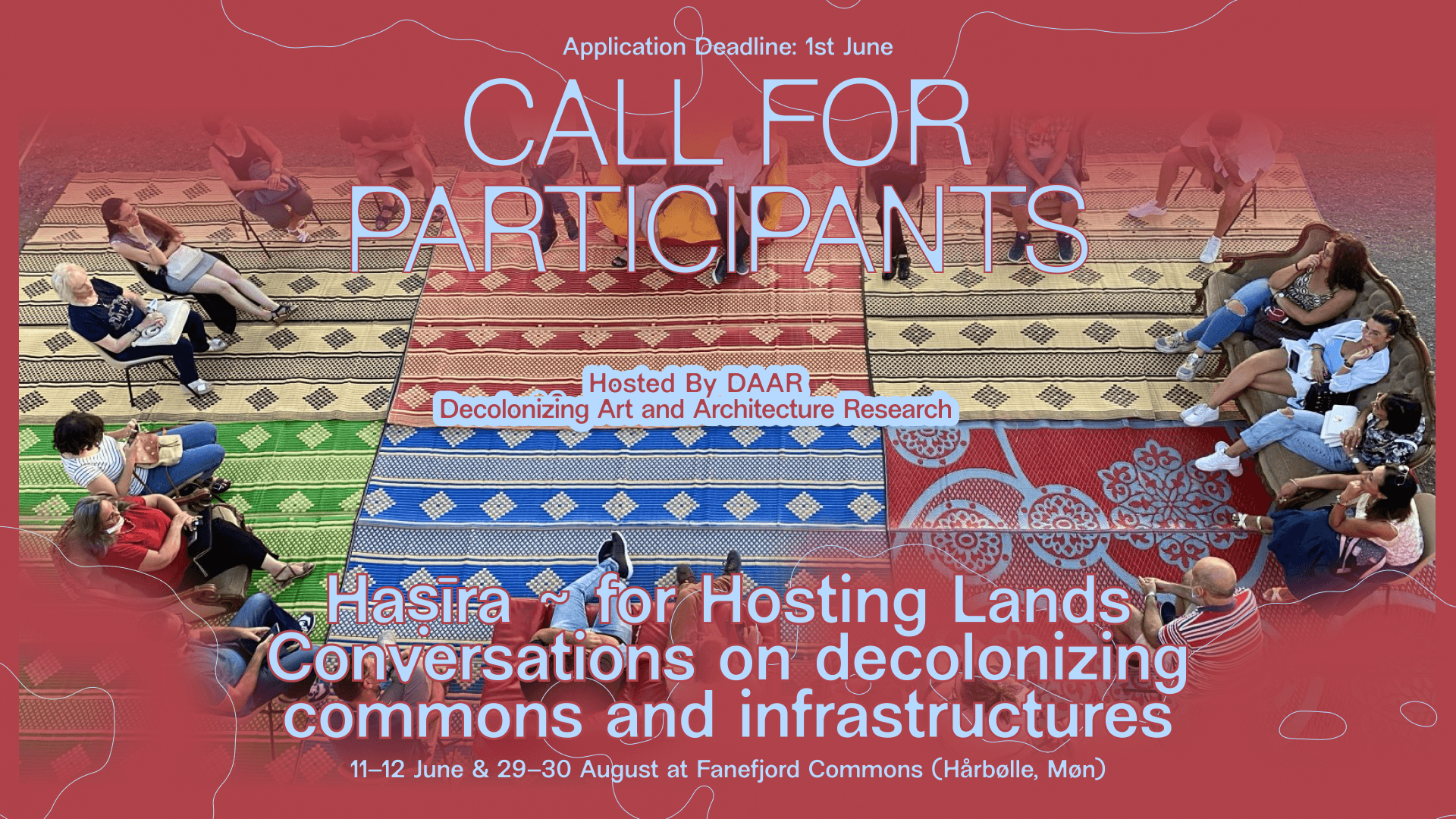
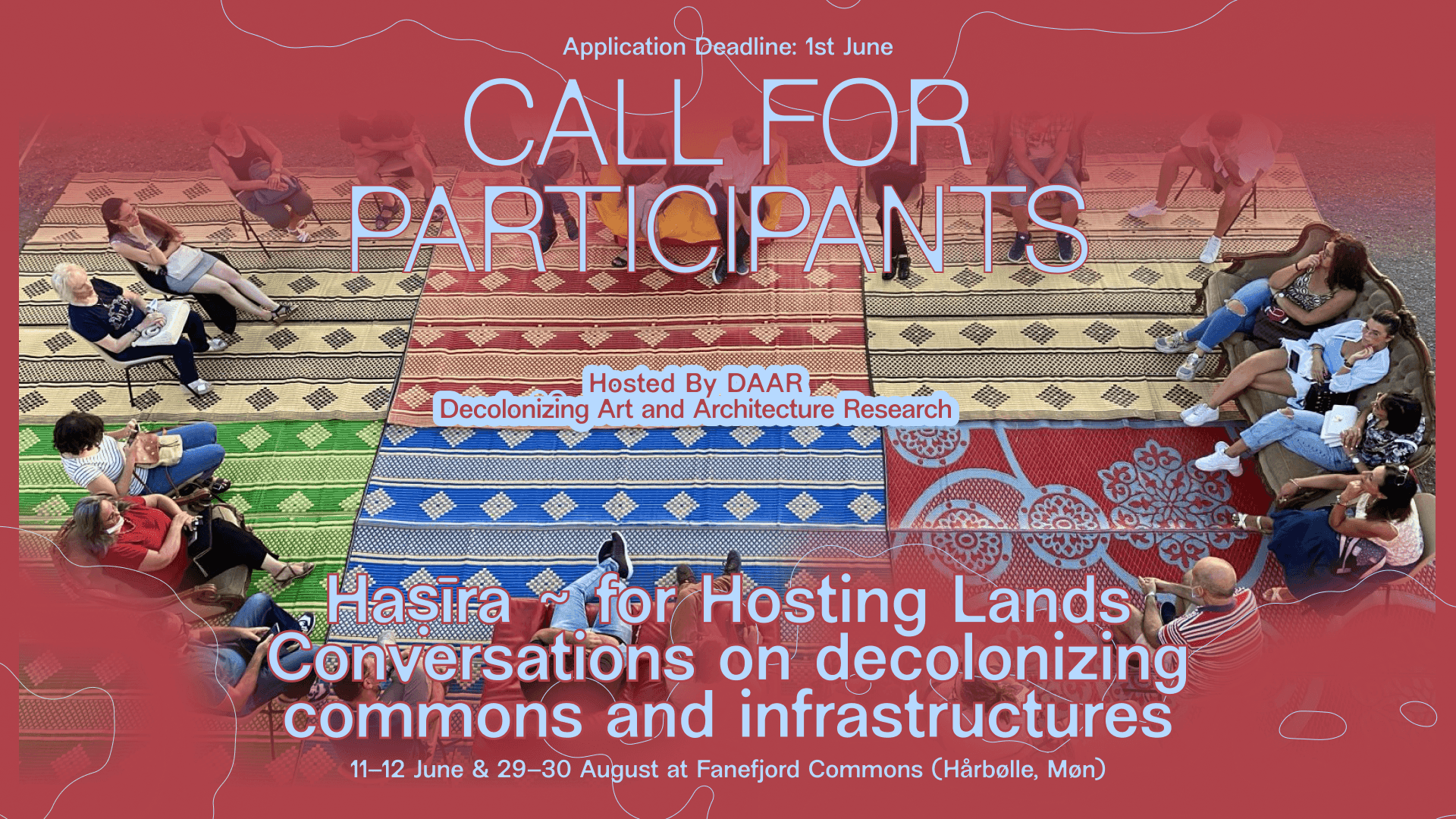
Drawn from the Arabic word ḥaṣīra (ﺣﺼﯿﺮة), meaning a portable, adaptable woven mat, the Hasira is able to turn any ground into a place for sitting, meeting, hosting, mourning, celebrating, striking, and gathering. Its root (ḥ-ṣ-r) means to frame, to enclose, to define limits. In Palestine, the ḥaṣīra frames territory, creates a room without walls, and declares: here we host, here we belong —for as long as we are here.
To frame is to make space —to lay the ḥaṣīra and call others in. To unframe is to refuse the limits imposed on where, how, and why we gather. Each time the ḥaṣīra is unrolled, it becomes as concrete as the ground it rests on. Light enough to carry, it adapts to each terrain, moves freely, and transforms space without waiting for permission. This adaptability is not only practical; it is political. It allows gatherings to emerge where formal infrastructure is absent, insufficient, or denied.
From Sicily to the Sydney Biennale, and now to Møn, Haṣīra travels as both a material and a practice —emerging from forms of practice shaped in Palestine, and opening itself to the conditions, struggles, and contradictions of each place it encounters. On Møn, Haṣīra lands within the context of the exhibition Hosting Lands, where conventional farmland has been bought in order to cultivate commons as exhibition strategy, as community desire, as a project of ecological regeneration and as a proposed practice of experimental inhabitation.
But to whom is this commoned piece of land and the fantasy it evokes accessible? Who are drawn into this space, who are invited to access, to dwell, to take (co)ownership and to belong?
And who is expelled and excluded from the fantasies of the commons crafted within rural Scandinavian landscapes, communities and well-intentioned art projects that rely on an often quite general and abstract notion of a ‘we’ – a notion which risk reproducing the hegemony of public space, rather than inverting or challenging it?
Haṣīra for Hosting Lands take its point of departure on Fanefjord Fælled – a piece of land which has been purchased for exhibition funding and commoned through exhibition infrastructure. Haṣīra consists of two gatherings (June 11-12th and August 29-30th) in which we will sit with questions of infrastructure, commoning and (non)belonging to land.
We will begin with a very concrete question: what infrastructure exists on the land, what is missing, and how does this shape who can use the place comfortably or uncomfortably? We approach infrastructure not only as electricity, water, or shelter, but as the conditions that allow people to stay, gather, rest, eat, wash, feel safe, and feel welcome. These are not neutral provisions; they shape intimate ways of being —how bodies move, how long one can remain, and how one relates to others and to the land itself.
In this context, Haṣīra can be understood as a temporary infrastructure: not a solution, but a frame that introduces other rituals, other practices, and other forms of encounter. It does not aim to improve the land, but to question how the land is being framed —who hosts, who is invited, and under what terms. In a context like Møn, where inclusion often presents itself as openness, Haṣīra asks what this inclusion produces, and what it quietly excludes.
Those who join Haṣīra are not coming to propose better solutions or to teach more correct ways of being in the world. They come to unlearn —to step away from the idea that there is one right way to gather, to care for land, or to live together. The task of Haṣīra is to open a space where dominant narratives of inclusion, infrastructure, and hosting can be questioned, interrupted, and reframed.
Participation:
Participation is free, but the capacity is limited, so we recommend sending in an application as swiftly as possible. We welcome participants from all fields and practices of knowledge, formal as informal, who feel called to spend time discussing these questions together in a focused setting, informed by politics of decolonization and environmental justice.
It is possible to take part in both encounters (June 11–12 and August 29–30), or only one of them. We ask everyone to send a short statement of interest for participation including a short introduction to yourself, and a description of your interest in the above-mentioned themes and how they relate –or not– to your current practice. Send your statement (MAX 1 page) to ida.bencke@gmail.com by june 1st the latest.
We will serve snacks, coffee, tea and a light vegetarian lunch throughout the programme days (please inform us about allergies or special requirements). If the weather allows, we will spend our time together outdoors, so wear practical clothes + appropriate sun protection.
The programme will start at 10.30 and will finish at 15.30 each day. If needed, we will assist with finding local accommodation. It is possible to bring tents for free camping at the Fanefjord commons.
For any questions or inquiries, and for any requests related to accessibility etc, please contact: ida.bencke@gmail.com
Haṣīra
is supported by
the Danish Arts Foundation
and
Bikubenfonden
Photo credit:
Ente di decolonizzazione, 2021